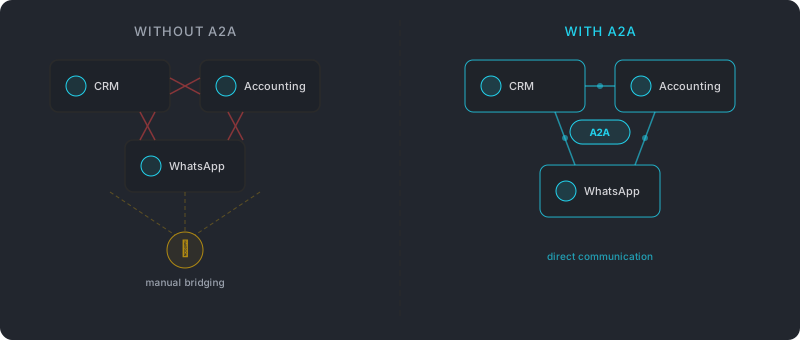
Imagine this situation. You have an AI agent that monitors orders in your online store. Another one that manages invoices in your accounting system. And a third that answers customer questions on WhatsApp.
Each works well on its own. But when a customer writes “where’s my order?”, the WhatsApp agent has no idea. It can’t check the order status, can’t confirm whether the invoice was issued, knows nothing about what the other two know. So it either responds with a generic message (“a colleague will contact you”) or gives up entirely and transfers to a human.
This isn’t an artificial intelligence problem. It’s a communication problem between systems. And that’s exactly the problem Google launched a standard to solve, one that could fundamentally change how AI agents work in business.
What the A2A protocol is
In April 2025, Google published the specification for Agent2Agent (A2A), an open protocol that allows AI agents built by different vendors, on different platforms, to communicate with each other, exchange information, and coordinate tasks.
It’s not a Google product you need to buy. It’s a public standard, published under the Apache 2.0 license and governed by the Linux Foundation. Anyone can implement it, modify it, and use it commercially at no licensing cost.
Over 50 technology companies already support the protocol: Salesforce, SAP, Atlassian, MongoDB, PayPal, ServiceNow, Workday. Add to that the major consulting firms (Accenture, Deloitte, PwC, McKinsey, KPMG) who will integrate A2A into the projects they deliver to their enterprise clients.
The adoption is significant not because Google proposed it, but because it solves a problem everyone had and nobody was addressing at the standards level.
The analogy that explains everything: email
In the early ’90s, if you had an email address on CompuServe, you couldn’t send messages to someone on AOL. Each system operated in its own bubble. It was only after the adoption of SMTP and IMAP protocols that what seems obvious today became possible: you send an email from Gmail and it arrives on Outlook, Yahoo, or any other service.
With AI agents, we’re at that exact pre-SMTP moment.
If you’ve built an agent on OpenClaw and your client uses a CRM system with its own Salesforce agent, the two have no way to talk to each other. Each lives in its own universe, with its own data, its own tools, its own internal language. Any connection between them requires custom integrations that are expensive and fragile.
A2A proposes exactly what SMTP did for email: a common language. It doesn’t matter who built the agent, what platform it runs on, or what language model it uses. If it follows the A2A protocol, it can collaborate with any other agent that does the same.
How it works, without the technical jargon
The protocol defines a few simple mechanisms:
Discovery. Each agent publishes an “Agent Card”, a file describing what it can do. An agent that needs help consults these cards and identifies the right agent for the task. Think of it as a digital business card: “I can check inventory”, “I can issue invoices”, “I can schedule meetings.”
Tasks. Communication is organized around tasks. A client agent formulates a request, a remote agent picks it up and works on it. Each task has a clear lifecycle: received, in progress, completed, failed. Both agents can communicate throughout to stay in sync.
Collaboration. Agents exchange structured messages. Not just text, but any format needed: images, files, forms, even audio or video.
Everything is built on existing, battle-tested technologies: HTTP, JSON-RPC, and Server-Sent Events. This isn’t a lab experiment. It’s an extension of the infrastructure the internet already runs on.
What this means for a small business, concretely
Let’s go back to the opening example, but in a version where A2A exists and works.
A customer writes on WhatsApp: “Hi, I ordered a product 3 days ago and it hasn’t arrived.” The agent handling conversations recognizes it’s about an order. Through the A2A protocol, it contacts the order management agent, which checks the status: “order X, shipped yesterday, tracking number in transit.” Back on WhatsApp, the customer gets a response in 10 seconds: “Your order was shipped yesterday. The tracking number is…”
No transfer to a human. No waiting. No custom integration between the two systems.
A few practical scenarios for SMEs:
Sales and accounting. The CRM agent closes a sale. Through A2A, it sends the data to the accounting agent, which automatically issues the invoice and sends it to the client. Today, in most companies, someone manually copies data from the CRM into invoicing software.
Recruitment. An agent filtering CVs finds a suitable candidate. Through A2A, it contacts the scheduling agent, which checks the manager’s availability and proposes three time slots to the candidate. Otherwise: emails, phone calls, back-and-forth.
Technical support and logistics. A customer reports a defective product. The support agent verifies the warranty, the logistics agent schedules a pickup, the accounting agent prepares the credit note. Three different systems, three different agents, one seamless experience for the customer.
Today, these scenarios require complex integrations between systems or, more commonly, people who manually bridge the gap. A2A promises to eliminate that bridging work.
How A2A could change the way businesses interact
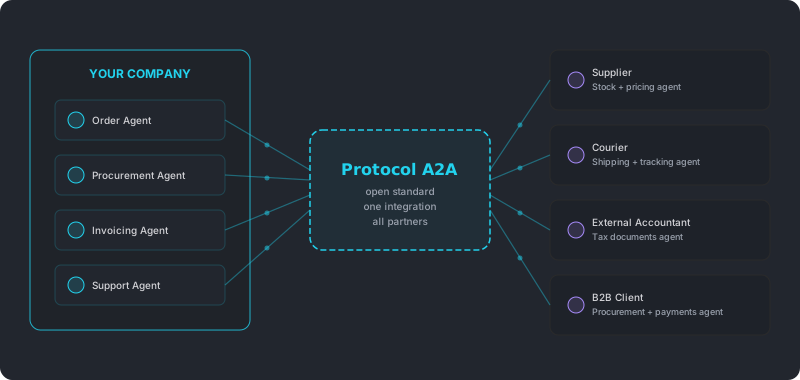
The examples above happen inside a single company. But A2A becomes truly transformative when agents cross company boundaries and communicate with agents from other organizations.
Think about the interactions your business has every day with suppliers, clients, your external accountant, couriers, banks. Each involves exchanging information, confirming details, waiting, and most of the time a person bridging the gap. A2A opens the possibility for these interactions to happen directly between agents, without human intermediaries.
Suppliers. Your procurement agent automatically checks availability with your supplier: “do you have 200 DN50 fittings in stock?” The supplier’s agent responds with actual stock levels, the current price, and delivery timeline. If everything checks out, the order is placed directly. No more emails sent in the morning with a reply the next day. No more phone calls where “let me check and I’ll call you back.”
External accounting. At month-end, your external accountant’s agent automatically pulls your issued invoices and payment records from your system. No more manual exports, no more emailing spreadsheets, no more worrying you forgot something. The accountant’s agent knows what data it needs, requests it through A2A, and your agent provides it in the required format.
Logistics and shipping. Your order agent schedules a pickup directly through the courier’s agent. It receives the tracking number automatically, and when the shipment status changes, the courier’s agent notifies your agent, which in turn updates the customer. A complete chain without anyone opening a courier portal or copying a tracking number from an email.
Business clients. If you sell to other companies, your client’s agent can directly check order status, request a proforma invoice, or confirm a payment, all through agents communicating via a standard protocol. The client doesn’t need to call, and you don’t need to answer.
This B2B dimension is what truly sets A2A apart from traditional integrations. Within your own company, you can build custom integrations between systems. It’s expensive, but feasible. Between companies, however, each partner has their own software, their own infrastructure, their own rules. When you have 5 suppliers, an external accountant, 3 couriers, and dozens of clients, custom integrations with each become impossible. A common standard is the only solution that scales.
Questions that remain open. Cross-company interoperability raises real issues that the protocol alone doesn’t solve:
- Security and access. What data do you expose to another company’s agent? Does the supplier’s agent see only stock levels, or also your cost prices? Granular access control becomes essential.
- GDPR and personal data. If your external accountant’s agent accesses invoices containing your customers’ data, compliance responsibility remains yours.
- Legal liability. If a supplier’s agent confirms an incorrect price and your agent places an order based on it, is that a contract? The legal framework hasn’t caught up yet.
These questions aren’t reasons to avoid the technology. They’re reasons to adopt it thoughtfully, to understand what you’re exposing, to set clear boundaries, and to keep human oversight on critical transactions. Exactly the way you’d handle a new employee whom you wouldn’t give access to everything on their first day.
A2A and MCP: two complementary protocols, not competitors
If you’ve read our article on AI agent platforms, you’ve seen that Anthropic developed a protocol called MCP (Model Context Protocol). A natural question is: do we need both?
The short answer: yes, because they solve different problems.
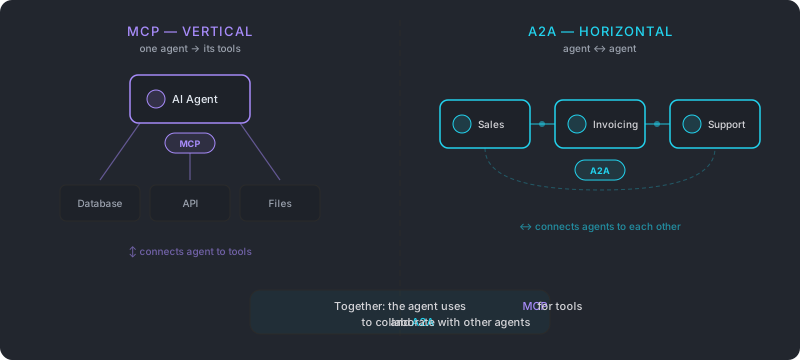
MCP is a vertical protocol. It connects an agent to the tools and data it needs to work: databases, APIs, files, external services. Think of MCP as an employee’s hands: they let them use the tools on their desk.
A2A is a horizontal protocol. It connects different agents to each other. Think of A2A as the common language in an office: it lets employees communicate and coordinate tasks, even if each works with different tools.
An accounting agent uses MCP to access the invoicing system. The same agent uses A2A to receive transaction data from the sales agent. The protocols work together, they don’t replace each other.
Why this matters
Businesses that adopt AI agents now and build on systems that support A2A won’t find themselves locked into a single vendor. Tomorrow they can add a second agent built on a different platform, and the two will know how to communicate. Without A2A, each new agent means a new custom integration, manual and costly.
Integration costs drop dramatically. For a small business, integrating two software systems can cost thousands and take weeks. If both systems support A2A, integration becomes a configuration, not a development project.
Software vendors will adopt these standards. As ERPs, CRMs, and ecommerce platforms implement A2A support, businesses already using compatible AI agents will be the first to benefit.
You don’t need to understand the protocol’s technical specification. You just need to understand the principle: your AI agents need to be able to communicate with the world around them, not just execute tasks in isolation.
What you can do now
A2A isn’t at full maturity yet. The production-ready version is planned for the second half of 2026, and real adoption in products used by SMEs will take at least a year after that.
But that doesn’t mean you should wait.
What you can do now is build correctly from the start. Choose well-defined problems, automate them with platforms that follow open standards, and make sure every agent you build has documented inputs and outputs. When interoperability is available natively, you’ll be ready to use it from day one.
The direction is clear: the future doesn’t belong to solitary agents, however intelligent they may be. It belongs to ecosystems of agents that collaborate. Just as a company doesn’t run on a single brilliant employee, but on a team that communicates.
The only question is whether your business will be part of that ecosystem or will be left with tools that don’t talk to each other.
If you’re exploring which processes in your company could be automated with AI agents, a 30-minute conversation can help you identify the best starting points.