If you’ve read our guide to AI agents, you already know what they are and why they matter. The practical question is: which platform do you start with?
In March 2026, three platforms dominate the autonomous AI agents space: OpenClaw (open-source, community-driven), Claude Code (Anthropic), and Codex (OpenAI). All three allow building agents that work independently, execute complex tasks, and communicate through messaging apps. But their approaches are fundamentally different.
OpenClaw - the community agent, for everything
OpenClaw emerged in November 2025 as developer Peter Steinberger’s personal project and exploded to over 186,000 GitHub stars within months. Nvidia called it “the most important software release in history” at the GTC 2026 conference, and Tencent integrated it into WeChat for over a billion users.
What makes it special is universality. OpenClaw isn’t tied to a single AI model - it works with Claude, GPT-4, Gemini, Llama, or any other model. It connects to over 10 messaging platforms (WhatsApp, Telegram, Slack, Discord, Signal, iMessage, Teams, Google Chat), can control a browser, generate voice, and execute scheduled tasks around the clock.
The architecture is built on a “skills” system (community modules) - on ClawHub, the official marketplace, there are hundreds of skills, from market monitoring to CRM management. The agent has persistent memory, learns from interactions, and becomes more useful over time.
Strengths:
- Open-source, zero licensing cost
- Works with any AI model
- Most messaging integrations (10+)
- Active skills ecosystem and massive community
- Self-hosted - your data stays on your server
- Most versatile: from business automation to personal assistant
Limitations:
- Initial setup requires technical knowledge
- Consumes significant resources (over 1GB RAM)
- Large codebase (~430,000 lines) - there have been security incidents
- Security and maintenance are your responsibility
We wrote a separate deep dive on OpenClaw with details on how it works and how we use it with clients.
Claude Code - Anthropic’s agent, with 3-day-old Channels
Claude Code started as a programming agent - it works in the terminal, writes and edits code, runs tests. But on March 20, 2026, Anthropic launched Claude Code Channels, and the game changed completely.
With Channels, Claude Code can be accessed through Telegram and Discord, with Slack, WhatsApp, and iMessage on the community request list. VentureBeat called it directly an “OpenClaw killer.” It’s no longer just a tool for developers - it’s becoming an autonomous agent you contact through chat, just like OpenClaw.
The underlying technology is Model Context Protocol (MCP), an open standard created by Anthropic - a kind of “USB-C” for AI, enabling standardized connection to external data and tools. Claude Code sessions can run persistently on a server, waiting for messages and autonomously executing tasks.
The main advantage over OpenClaw? Simplicity and security out of the box. You don’t need to configure a complex server or worry about vulnerabilities. Anthropic handles security, and setup is native - create a Telegram bot, install the plugin, and you’re done.
Strengths:
- Backed by Anthropic - security and safety as priorities
- Simple, native setup without complex server configuration
- Claude as the AI model - excellent at reasoning, code, and analysis
- MCP as an open standard for integrations
- Agent Teams - sub-agents that collaborate on parallel tasks
Limitations:
- Only Claude as the model (you can’t use GPT-4 or Gemini)
- Channels currently only available on Telegram and Discord (no WhatsApp, no iMessage)
- Not open-source - you depend on Anthropic
- Launched 3 days ago - ecosystem still in early stage
- Requires a Claude subscription (Pro or Max)
Codex - OpenAI’s agent, cloud-native
Codex is OpenAI’s answer to Claude Code. It runs entirely in the cloud - each task runs in its own isolated container, which brings security through separation, but also limitations.
According to WIRED, Codex grew from 5% of Claude Code’s usage in September 2025 to 40% in January 2026 - significant progress, though Claude Code remains the leader with 54% of the enterprise coding market.
Codex is integrated into the OpenAI ecosystem and works natively with GPT models. It has a dedicated macOS app (launched February 2026) and organizes tasks by project, in separate threads.
Strengths:
- Cloud-native - nothing runs locally, everything happens on OpenAI’s servers
- Per-task isolation - each task runs in a separate container
- Integrated with the OpenAI ecosystem (GPT, APIs, Whisper, DALL-E)
- Dedicated macOS application
Limitations:
- Cloud-only - data passes through OpenAI’s servers
- macOS only for now (desktop app)
- No messaging integrations (you can’t contact Codex via WhatsApp or Telegram)
- Only GPT models (you can’t use Claude or Gemini)
- Agents can’t collaborate with each other (no equivalent to Agent Teams)
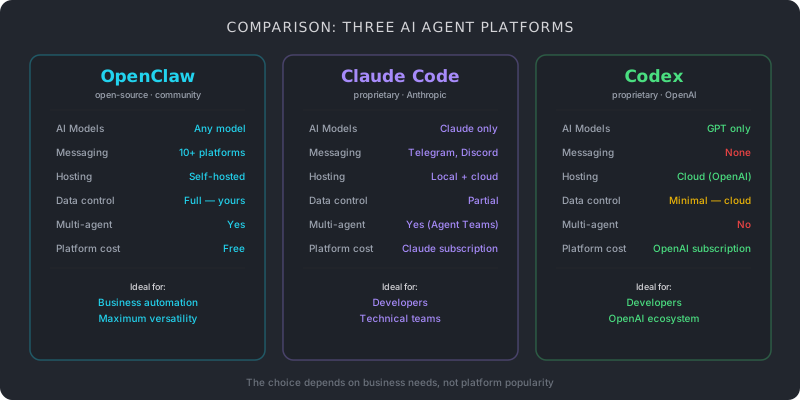
How they compare
| OpenClaw | Claude Code | Codex | |
|---|---|---|---|
| Type | Open-source | Proprietary (Anthropic) | Proprietary (OpenAI) |
| AI Models | Any (Claude, GPT, Gemini, Llama, local) | Claude only | GPT only |
| Messaging | 10+ (WhatsApp, Telegram, Slack, Discord, Signal, iMessage…) | Telegram, Discord (3 days) | None |
| Runs on | Your server | Local + cloud | Cloud (OpenAI) |
| Data control | Total (self-hosted) | Partial | Minimal (cloud) |
| Security | Your responsibility | Managed by Anthropic | Managed by OpenAI |
| Setup | Complex | Moderate | Simple |
| Multi-agent | Yes (multi-agent routing) | Yes (Agent Teams) | No |
| Platform cost | Free | Claude subscription | OpenAI subscription |
| Community | 186K+ GitHub stars, ClawHub | Growing | Growing |
| Ideal for | Business automation, maximum versatility | Developers, technical teams | Developers in the OpenAI ecosystem |
Our recommendation
It depends on what you want to do:
If you want to automate business processes - monitoring, alerts, client communication, data processing - OpenClaw remains the primary choice. It’s the only one that connects to WhatsApp (essential in many markets), works with any model, and adapts to any workflow. It requires technical expertise to configure, but offers flexibility the others can’t match.
If you’re a developer or have a technical team and want a powerful coding agent that gradually becomes a general assistant too, Claude Code with Channels is promising. Setup is simpler, security is managed, and Agent Teams allow parallel work. But the ecosystem is young and messaging integrations are still limited.
If you’re already in the OpenAI ecosystem and want a cloud-native coding agent, Codex works well in its niche. But without messaging integrations and without self-hosting capability, it’s not a solution for business automation.
For SMEs wanting concrete automation results, we’ve implemented this for AutoDE, an automotive dealer in Bucharest - OpenClaw on a dedicated server, automated monitoring, WhatsApp alerts. Technology matters, but what matters more is choosing the right fit for your business’s actual needs.
The landscape is evolving fast. Claude Code Channels is 3 days old. Codex is growing aggressively. But OpenClaw, with its community and ecosystem, remains the foundation on which the most is being built - including by Nvidia, which just launched NemoClaw, an enterprise security wrapper, at GTC 2026. We’ll cover that in a separate article.