Gartner estimates that over 40% of agentic AI projects will be abandoned by 2027. Not paused, not rescheduled. Abandoned.
At first glance, the number seems counterintuitive. We’re living in the moment when AI has become more accessible than ever. Open-source platforms can be configured in hours. Costs have dropped by an order of magnitude in two years. Case studies are everywhere.
And yet, most projects die before producing any real value.
I’ve analyzed enough implementations, spoken with enough business owners, and built enough systems to understand why. And the conclusion is consistently the same:
The problem isn’t the AI. The problem is everything that comes before it.
Failure has a pattern
When an AI agent project fails, it’s rarely because the language model made a mistake or the platform had a critical bug. Failures follow a recognizable pattern, with a few main variations. I’ll go through them one by one, not as a checklist to tick off, but so we can understand the logic behind each.
Mistake #1: You chose the impressive problem, not the painful one
Most companies’ first instinct is to build something visible. A chatbot on the website. A virtual assistant that answers emails in your style. An agent that automatically generates reports from complex data.
All of these sound great in a presentation. Few survive contact with reality.
The problem isn’t that they’re technically impossible. It’s that they don’t target something that truly hurts, happens frequently, and can be measured.
The best candidate for your first AI agent is usually the most boring one. A task that repeats daily or weekly. A process someone on your team has been doing manually for years, one that doesn’t require real judgment, just execution. Something with clear input and a clear output.
At AutoDE, a car dealer in Bucharest, employees were spending two hours a day manually searching autovit.ro and OLX for underpriced cars. Nobody would have put this on a “digital transformation” agenda. But a monitoring agent running every 30 minutes eliminated that task entirely. Concrete savings: over €120 per day.
Not a chatbot, not a strategic assistant. Automation of a repetitive, boring, and expensive process.
Before deciding what you want to build, ask yourself this question: What task in my company happens most often, the team complains about most, and doesn’t actually require difficult judgment?
That’s where your first agent should go.
Mistake #2: You put AI on a broken process
AI accelerates execution. If the process you’re automating is already chaotic, AI produces chaos faster.
This is one of the hardest lessons I’ve observed. A company sets out to automate follow-ups with potential clients. But there’s no clear definition of what “potential client” means. There’s no consistent convention for CRM statuses. There’s no team-agreed message template. Database fields are incomplete or inconsistent.
The AI agent runs, sends messages, but the messages are wrong or sent to the wrong people. The project gets shut down in two weeks.
Any process you want to automate must already work at the human level. Not perfectly, but consistently enough. You should be able to describe the steps to a new colleague in 10 minutes and expect them to execute it correctly.
If you can’t do that, you don’t have an automation problem. You have a process problem. Fix that first.
A simple check: if you hired a dedicated human assistant for this task tomorrow, could they execute it consistently by the second week? If the answer is no, AI won’t save you.
Mistake #3: You wanted everything at once
There’s a tendency, especially after someone sees a spectacular demo, to think big. “Let’s automate the entire sales flow.” “Let’s build a system that handles all supplier communication.” “Let’s create an agent that monitors all platforms and also generates reports and sends alerts and…”
This approach kills projects systematically.
Not because it’s technically impossible. But because as system complexity grows, failure points multiply exponentially. If each component of a complex system has a 90% success rate, a system with 10 components has a total success rate of 35%.
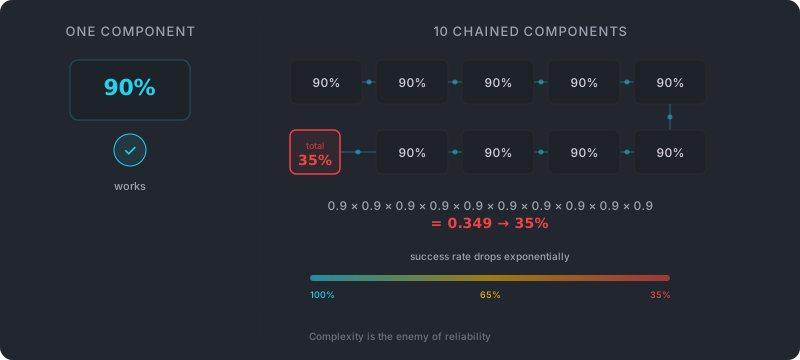
The approach that works is the exact opposite: a small, well-defined pilot project with a single measurable objective. Run it for a month. Measure. Adjust. Expand.
The benefits go beyond risk management. A small pilot lets you learn how AI behaves in the specific context of your company, with your real data, with your team. The lessons from that pilot are more valuable than any external documentation or case study.
The rule I apply with clients: your first agent should solve one problem and be evaluable after 30 days. If it can’t be evaluated in 30 days, it’s too complex for a starting point.
Mistake #4: The team found out last
I talk to business owners who built technically functional AI systems that failed in implementation because the team wasn’t involved.
The typical scenario: a manager decides to automate a process. The system is ready. Employees who worked on that process are told “the AI handles it now.” They weren’t consulted during design. They don’t know exactly what the agent does. They have no clear mechanism for reporting problems or unexpected behavior.
Result: passive resistance, workarounds, incorrectly entered data, and within months the system is abandoned or completely bypassed.
People don’t oppose AI itself. They oppose changes imposed without context, without dialogue, and without clarity about what it means for their role.
The team needs to be involved from the design phase, not the launch phase. The people executing the process today know details no manager knows: the exceptions, the edge cases, the moments when the general rule doesn’t apply. Without this information, you’ll build an agent that works in 80% of cases and breaks on the rest.
Moreover, people who contributed to the design become the system’s best advocates. They’ll use it, defend it, and improve it.
Mistake #5: You never defined what success looks like
This is perhaps the most subtle failure, because the project can continue for months without anyone realizing it isn’t working.
If you don’t have a clear metric before launch, you can’t know whether your agent is producing value or just producing activity. “It works” isn’t a metric. “We automated the process” isn’t a metric.
The metrics that matter are usually simple: time saved per week, number of errors reduced compared to manual execution, cost per automated task versus cost of manual execution, value generated directly (leads, sales, cash recovered).
If you can’t put a number on the value you want to create, you’ll evaluate success subjectively. And subjective evaluations tend to be favorable at first and catastrophic at the first problem.
Define before launch what success looks like at 30 days, at 90 days, and at 6 months. This forces you to think concretely and gives you the basis for informed decisions going forward.
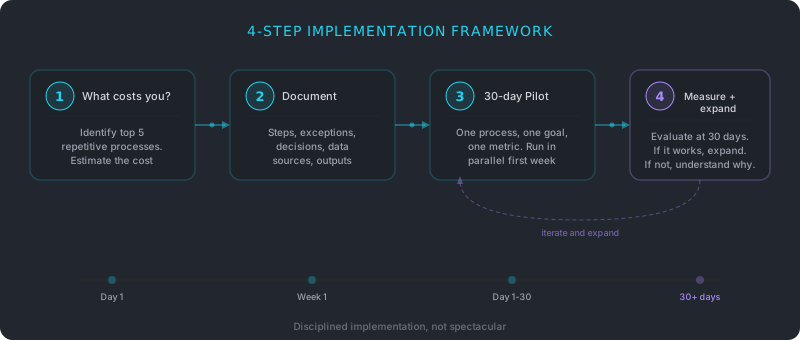
What you can do differently: a 4-step framework
Everything above converges toward a way of thinking about implementation that’s different from what most companies do:
1. Start from what costs you, not from what’s possible
Don’t start from “what can I do with AI” but from “what costs me the most in time, money, or headaches right now.” List the top 5 repetitive processes in your company, estimate their monthly cost in person-hours, and pick the one with the highest cost and the clearest execution path.
2. Document the existing process
Before you automate anything, describe it completely. The steps, exceptions, decisions, data sources, where the output goes. If you can’t document it, you can’t automate it well.
3. Launch a 30-day pilot
One process, one objective, one success metric. Run it in parallel with manual execution for the first week so you can compare. Actively collect feedback from the team.
4. Measure, adjust, expand
At 30 days, evaluate against the metric you set. If it works, expand. If it doesn’t, understand why before expanding. The lessons from a small pilot are cheaper than large-scale failures.
Technology isn’t the barrier
If there’s one message I want you to take away from everything above, it’s this:
The barrier isn’t technological.
The platforms are mature, accessible, and they work. AI models are better than ever. The cost of entry has dropped dramatically. If your AI agent project fails, the cause is almost certainly one of the five mistakes above, not a limitation of the technology.
The good news is that all of these mistakes are avoidable. Not with large budgets or technical expertise, but with discipline in the implementation process and clarity about what you want to achieve.
Romania has an AI adoption rate of 5.2% in business. Concerning, but also a real opportunity. Companies that implement correctly now aren’t competing with Denmark or with tech corporations. They’re competing with their market neighbors who are still working manually.
The advantage doesn’t need to be large to be decisive.
If you’re at the stage of exploring which processes could be automated in your company, a free 30-minute AI audit is the best first step. Not a sales pitch, but a concrete analysis of your situation.