The term “AI agent” is everywhere - in the news, on LinkedIn, in conference presentations. But between the hype and reality there’s a considerable gap, and if you run a business, you need a clear picture, not pretty words.
This article is that picture. Not a sales pitch - a map of the AI agents ecosystem as it stands in March 2026: what works, what doesn’t, and where it’s all heading.
What is an AI agent, really?
A chatbot answers questions. An AI agent executes tasks.
When you open ChatGPT and ask “how do I write a follow-up email?”, you get text that you copy and send yourself. Useful, but the work still falls on you.
An AI agent works differently. You tell it “send a follow-up email to all clients who haven’t responded in the last 3 days” - and it actually does that. It accesses the CRM, identifies the clients, generates personalized emails, sends them, and reports back to you.
The fundamental difference is autonomy. A chatbot is reactive - it responds when you ask. An agent is proactive - it receives an objective and works independently to achieve it, making decisions along the way.
What makes this possible now, and not two years ago? Three things converged:
Language models got good enough. Claude, GPT-4, Gemini - they don’t just generate text, they can plan sequences of steps, evaluate results, and self-correct when something goes wrong. This qualitative difference is what makes real autonomy possible.
Open-source platforms democratized access. You no longer need a team of engineers and a corporate budget. Platforms like OpenClaw allow building sophisticated agents with modest resources.
Integration with existing channels eliminated adoption barriers. Agents deliver results via WhatsApp, Telegram, email - you don’t need to convince your team to learn new software.
The numbers behind the hype
It’s worth looking at what research firms are saying, because the data is striking:
Gartner estimates that 43% of organizations are considering adopting agentic AI in 2026, and 40% of enterprise applications will include task-specific agents by year’s end - a dramatic jump from under 5% in 2025.
McKinsey values the potential impact of AI agents at $2.6–$4.4 trillion annually in added value, distributed across customer service, finance, operations, sales, and marketing.
But the numbers come with a serious warning: Gartner also predicts that over 40% of agentic AI projects will be abandoned by 2027 - due to runaway costs, lack of governance, and unclear business value.
In other words: the technology works, but wrong implementation doesn’t get forgiven.
The anatomy of an AI agent
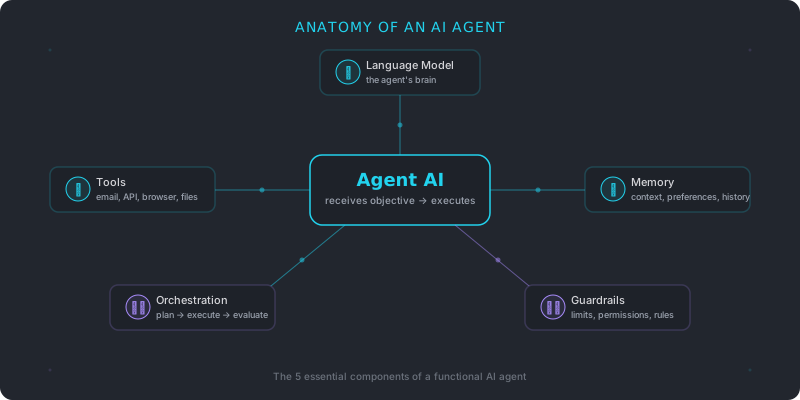
Regardless of platform, a functional AI agent has a few key components:
A language model - the agent’s brain. Claude, GPT-4, Gemini, or an open-source model like Llama. This understands instructions, plans steps, evaluates results, and makes decisions. The quality of the model directly determines the quality of the agent.
Tools - the agent’s hands. Access to email, WhatsApp, browsers, databases, APIs, files. Without tools, the agent is a sophisticated chatbot. With tools, it becomes an executor.
Memory - accumulated experience. What it’s done in the past, what your preferences are, what context is relevant. Without memory, every interaction starts from zero. With persistent memory, the agent becomes more useful over time.
Orchestration - coordination logic. How it decides which tool to use, in what order, what to do when something fails. For simple agents, this is a plan → execute → evaluate loop. For complex systems, it involves multiple specialized agents collaborating.
Guardrails - boundaries. What it’s allowed to do and what it isn’t. Where it needs human confirmation. What data it can’t access. An agent without guardrails is a risk, not an advantage.
Categories of solutions
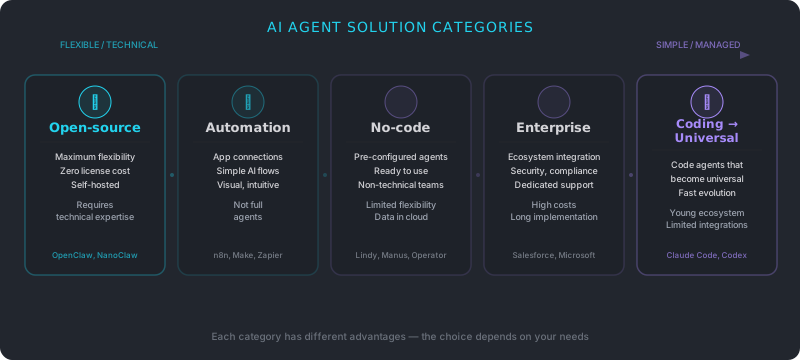
The agentic AI ecosystem diversified rapidly in 2026. Here are the five major categories:
Open-source platforms
Frameworks you install on your own server and configure to your needs. Most flexible, zero licensing cost, total control over data. The downside: technical expertise required.
Key examples: OpenClaw, NanoClaw, Nanobot, ZeroClaw. We wrote a deep dive on OpenClaw - the most popular in this category.
Pre-configured agents (no-code)
SaaS platforms offering ready-to-use agents with no coding. Work immediately, ideal for non-technical teams. The trade-off: limited flexibility, recurring monthly costs, and data passes through the vendor’s cloud.
Key examples: Lindy, Manus AI, ChatGPT Operator (OpenAI), Claude Cowork (Anthropic), Jace AI.
Automation platforms with AI
Tools for connecting existing apps, augmented with AI capabilities. Not full agents, but they solve many problems without excessive complexity. Good for repetitive workflows.
Key examples: n8n (open-source), Make, Zapier, LangChain / LangGraph.
Enterprise solutions
Platforms integrated into major software vendors’ ecosystems. Deep integration, enterprise-grade security and compliance. But also significant costs and lengthy implementation cycles.
Key examples: Salesforce Agentforce, Microsoft Copilot Studio, AWS Bedrock Agents, Google Vertex AI Agent Builder, IBM watsonx.
Coding agents (becoming universal agents)
The fastest-growing area in 2026 - and the fastest-evolving. Claude Code (Anthropic) just launched Channels, enabling communication via Telegram and Discord, directly entering OpenClaw’s territory. Codex (OpenAI) is growing aggressively. The line between “coding agent” and “general agent” is blurring fast.
Key examples: Claude Code (Anthropic), Codex (OpenAI), GitHub Copilot.
We compared the three major AI agent platforms - OpenClaw, Claude Code, and Codex in a dedicated article.
Real risks
The enthusiasm is justified, but it shouldn’t obscure the risks:
Runaway costs. An agent runs continuously. Every action consumes tokens. IDC forecasts a 1000x increase in inference demand by 2027. Smart organizations use cheaper models for routine tasks and premium models only where it counts.
Unintended actions. An agent with email access can send the wrong message. An agent with data access can expose sensitive information. Guardrails aren’t optional - they’re critical.
Lack of transparency. When an agent makes a decision, you need to be able to understand why. “Black box” isn’t acceptable for a business - especially in regulated industries.
Project abandonment. The most common causes: unclear objectives, lack of governance, and trying to automate too much too quickly. The universal analyst advice: start with a clear use case with measurable ROI, and expand from there.
Where it works best in 2026
These aren’t hypothetical scenarios - these are domains with documented results:
Customer service - agents that autonomously handle refunds, escalations, and omnichannel support. Small teams save over 40 hours per month.
Finance and operations - automated invoicing, forecasting, expense auditing. Closing processes accelerate by 30–50%.
Sales and marketing - lead generation, personalized outreach, automatic qualification. 2–3x improvements in pipeline velocity.
Monitoring and alerting - market scanning, competitive intelligence, multi-platform data. We implemented this concretely for AutoDE, an automotive dealer in Bucharest - an AI agent that scans multiple sources every 30 minutes and sends alerts via WhatsApp. Over 2 hours saved per employee per day.
What’s coming next
Multi-agent systems - instead of one agent doing everything, multiple specialized agents collaborating. Gartner and Forrester consider this the dominant direction for the second half of 2026.
Physical AI - agents that coordinate robots, sensors, and logistics systems in real time. Deloitte estimates significant adoption in manufacturing and logistics by 2027.
Open protocols - initiatives like Project NANDA (MIT) for open agent-to-agent protocols, avoiding lock-in to a single ecosystem.
How to choose
There’s no universal solution. But a few questions can guide you:
How unique is your process? If your needs are standard, a no-code solution may work. If your process is industry- or company-specific, you need the flexibility of an open-source platform.
How sensitive is your data? If you work with financial, medical, or customer data, a self-hosted solution eliminates cloud exposure risk.
Do you have access to technical support? If yes, open-source platforms offer the best value. If not, a no-code solution gets you started faster, albeit with less control.
How much do you want to scale? If you have a single use case, a simple automation works. If you want an ecosystem of automations that grows with your business, investing in a flexible platform pays off quickly.
Each category will be covered in detail in a separate article. We start with a comparison of the three major platforms - OpenClaw, Claude Code, and Codex.