If you’ve read our guide to types of agentic AI solutions, you saw that open-source platforms offer the best value for SMEs. OpenClaw is the most well-known in this category - and for good reason.
What it is, in brief
OpenClaw is an open-source platform that lets you build autonomous AI agents. The agent can browse the web, send messages, access databases, read and write files, and execute complex tasks - without human intervention.
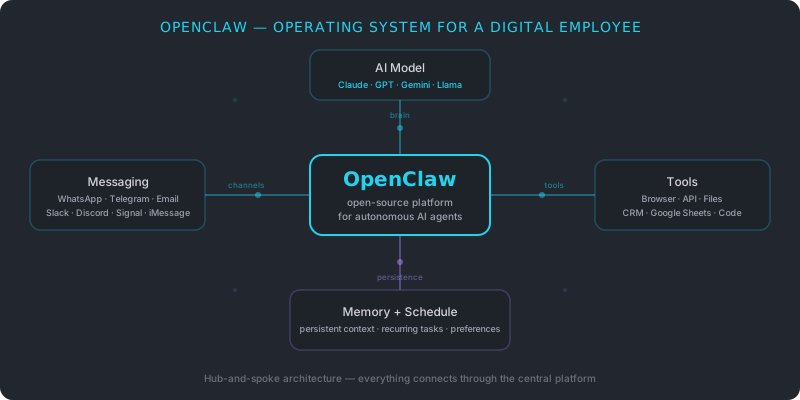
The simplest way to understand it: it works like an operating system for a digital employee. You define its role, give it access to the tools it needs, and it works.
Why it exploded in 2026
OpenClaw existed before, but 2026 put it on the global map. This month, Tencent integrated it directly into WeChat - over a billion users now have access to an AI agent powered by OpenClaw, right from chat. Baidu built agents on the same technology for desktop and smart-home, and Alibaba drew from its architecture for Wukong, their enterprise platform.
When the biggest tech companies in China simultaneously build on the same open-source foundation, it’s clear we’re not talking about an experimental project anymore.
How it works (without jargon)
Think of a new hire joining your company. To be useful, you give them a few things:
A role description - what they do, what they don’t do, what rules they follow. In OpenClaw, these are configuration files. You essentially describe the personality and boundaries in plain text.
Work tools - access to email, WhatsApp, browsers, Google Sheets, CRM. OpenClaw connects to all of these through plugins. The agent uses them on its own, when needed.
Memory - a notebook where it records what it’s learned, what was discussed, what your preferences are. Without this, you’d have to explain everything from scratch with every interaction. With persistent memory, it becomes more useful over time.
A schedule - recurring tasks at set times. “Check email at 9 AM.” “Scan the competition every hour.” “Send the sales report on Fridays at 5 PM.”
There’s nothing mysterious about it - it resembles organizing an internal process, except the executor is an AI instead of a person.
What it can concretely do
A few things we’ve implemented or seen working:
Monitoring and alerting - an agent that scans websites (competition, listing platforms, social media mentions) and notifies you on WhatsApp when something relevant appears. You don’t have to check, you don’t have to remember.
Automated communication - WhatsApp responses based on your company’s information (prices, availability, scheduling). Not generic responses - responses that account for the real context of your business.
Data processing - extracting information from documents, automatically completing reports, analyzing trends from the CRM. Things that normally consume hours of manual work.
Research - monitoring industry news, daily summaries, identifying opportunities. The agent reads what you don’t have time to read.
Why it makes sense for a small business
Three practical reasons:
Cost. The platform itself is free (open-source), and operating costs are significantly lower than those of an equivalent employee. Compare this to enterprise SaaS solutions starting at thousands of euros per month - for similar or even more limited functionality.
Data control. The agent runs on your server. Conversations, customer data, internal information - everything stays with you. It doesn’t pass through third-party clouds. For many industries, this isn’t a luxury, it’s a necessity.
Flexibility. You’re not limited to what a vendor designed. Your business process is unique? The agent is configured exactly for it. And as you discover new automation opportunities, you add them - without switching platforms or paying more.
The downside? Initial configuration isn’t trivial. You need someone who knows what they’re doing - either in-house or a consultant. But this is a one-time investment. After that, maintenance is minimal.
The ecosystem around OpenClaw
OpenClaw isn’t the only option in the open-source family. A few interesting forks:
NanoClaw emphasizes security - runs in isolated containers, ideal if you work with sensitive data. Nanobot is ultra-minimalist, about 4,000 lines of code (vs. hundreds of thousands in OpenClaw) - good if you want total transparency. ZeroClaw is written in Rust, starts almost instantly - useful for edge applications or resource-constrained environments.
All start from the same foundation, but are optimized for different needs. Worth knowing about, even if for most SMEs standard OpenClaw is more than sufficient.
What it looks like in practice
We implemented OpenClaw for AutoDE, an automotive dealer in Bucharest. Employees were spending up to 2 hours a day doing repetitive searches across various websites.
Now they have an AI agent on a dedicated server that scans multiple platforms every 30 minutes, analyzes each listing, and sends alerts to WhatsApp. The team only receives real opportunities, with a direct link.
Time saved: over 2 hours per day per employee. Opportunities captured in minutes, not hours. And the cost? A fraction of what an additional person doing the same task would cost.
It’s a simple example, but illustrative - and exactly the type of automation that can be replicated across any industry with minimal adaptation.
What’s next
This is the first article in a series where we go deep on each AI agent platform that matters in 2026. Next up: Claude Code (Anthropic), Codex (OpenAI), and n8n with AI - each with its specific strengths and use cases.