Romania has the fastest fixed internet in Europe. It has one of the largest developer communities in the region. And it has, according to Eurostat, the lowest rate of AI adoption in business in the entire European Union: 5.2%.
This isn’t a number from 2020. It’s from the Eurostat survey published in December 2025, with data collected in the same year. And it doesn’t refer to startups or freelancers - it covers companies with a minimum of 10 employees.
The EU average adoption rate is 20%, nearly 4 times higher than Romania’s. Denmark leads the pack at 42%, followed by Finland (37.8%) and Sweden (35%), while Romania sits at the bottom of the ranking, behind Poland (8.4%) and Bulgaria (8.5%).
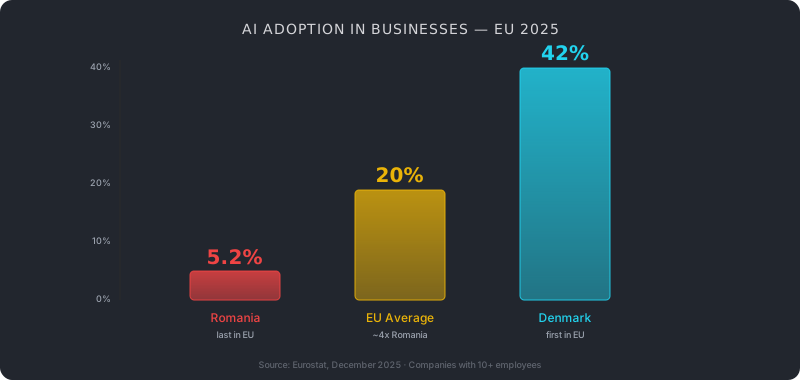
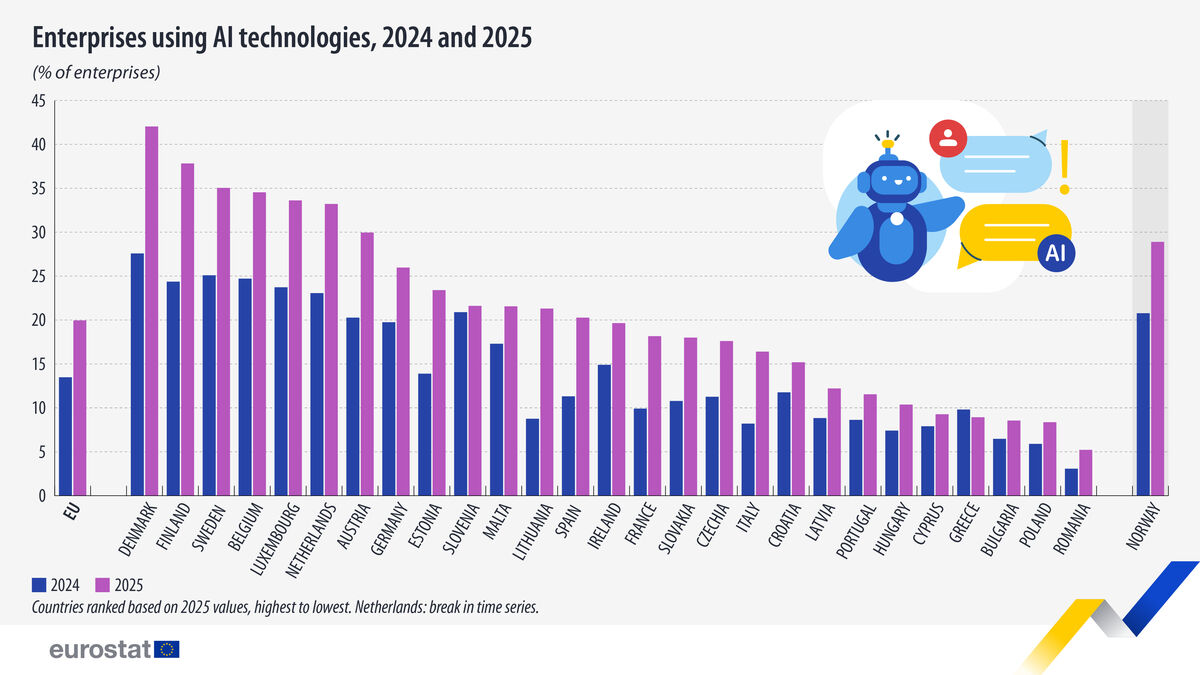 Source: Eurostat, December 2025. Percentage of companies with 10+ employees using AI technologies.
The European trend is accelerating: the EU average grew from 7.7% in 2021 to 13.5% in 2024, then jumped to 20% in 2025 - 6.5 percentage points in a single year. Denmark grew by 14.5 percentage points in one year. The gap isn’t narrowing - it’s widening.
Paradoxically, Romanians are actually using AI
A national survey by Reveal Marketing Research from early 2026 shows that 68% of Romanians have used AI tools at least occasionally, and 44% are already using them for work tasks - administrative support, analysis, content creation.
So it’s not that Romanians don’t know what AI is. Nearly half are already using it at work. The problem is they’re doing it individually, haphazardly, without direction - companies have no strategies, systems, or processes to channel this spontaneous adoption, and management rarely capitalizes on it.
Imagine that almost half your employees are already using ChatGPT or Gemini for various tasks. But each is doing something different, in their own way, without it being integrated into the company’s workflows - and not necessarily efficiently.
They use AI, but do they know how to use it?
There’s also an important nuance. Only 32% of Romanians between 16 and 74 have basic digital skills - the lowest percentage in the EU, where the average is 56%, and the Netherlands and Finland exceed 80% (Eurostat, 2025).
So we have a double paradox: people use AI, but many don’t even have basic digital skills. The gap between opening ChatGPT out of curiosity and systematically integrating AI into company processes is enormous - and bridging it can turn mere curiosity into a genuine competitive advantage.
This is exactly where the real opportunity lies - not just in implementing technology, but in educating teams on how to use it effectively.
Why it’s becoming urgent
All the numbers above would be concerning even in a growing economy. But Romania isn’t growing - at least not right now.
ING’s analysis from February 2026 puts things in context: Romania entered a technical recession at the end of 2025, with GDP growth of just 0.6% for the full year. Real wages fell by ~5%, inflation is near double digits, and the minimum wage has grown ~15% annually over the past decade. Meanwhile, the active workforce is contracting - low birth rates and emigration.
Their conclusion: “As wages have risen and the labor force has shrunk, companies have naturally begun to turn toward investments in robotics and automation.”
In other words, economic pressure is transforming AI from a luxury into a necessity. Companies that don’t automate will be caught between rising costs and competitors operating more efficiently.
And yet, this is an opportunity
If 94.8% of Romanian companies don’t use AI, any intelligent automation puts you in a disproportionately advantageous position. You’re not competing with Denmark. You’re competing with companies that still scroll manually, reply to emails with copy-paste, and process data in Excel.
We saw this concretely with AutoDE, an automotive dealer in Bucharest. By simply automating a repetitive search process, they freed up 2 hours per day per employee - translating directly into savings of over €120 per day.
In a market with 5% adoption, this kind of advantage isn’t marginal - it’s transformational.
And the productivity numbers back it up: according to Deloitte and McKinsey analyses, automation can reduce operating costs by 20–40%, and an employee using AI effectively saves between 45 minutes and 2.5 hours per day. In a company of 50 employees, that translates to the equivalent of 4 to 15 full-time employees per month.
Want to find out how you can make your processes more efficient and reduce costs with AI? Schedule a free 30-minute conversation and let’s explore it together.
Sources: Eurostat (December 2025), ING THINK (February 2026), EnterTech 2026 / Business Review (March 2026), HumAInity 2026 / Business Review (March 2026).