The correct answer to this question is: neither one, nor the other.
A lot of noise has already been created around AI.
Some treat it like magic. They ask a question, get an answer, and expect everything to be correct, complete, and ready to use.
Others try it twice, see a mistake, and conclude that it’s not worth it.
Both reactions stem from the same problem: wrong expectations.
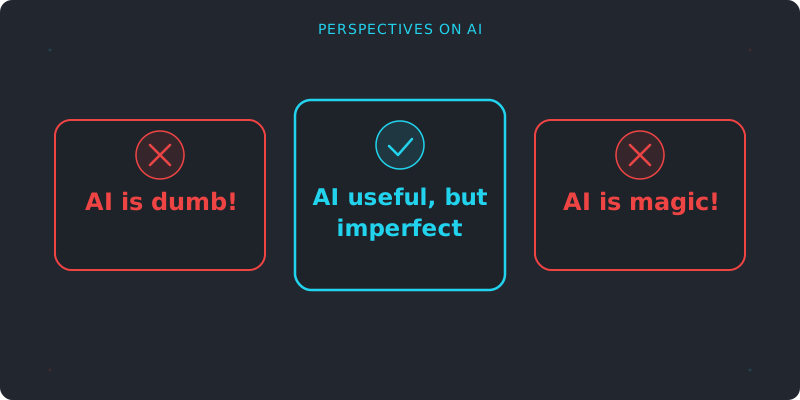
AI is neither magic nor nonsense. It is a tool. A very useful one, but imperfect. And if you use it with the right expectations, it can save you a lot of time and make your work much more efficient. If you use it poorly, it will give you exactly the kind of vague, wrong, or useless answer you deserve.
Yes, it sounds a bit harsh. But it’s very true and you need to understand this!
Why some believe AI is dumb
Because, sometimes, it really seems that way.
It can invent information. It can miss the exact important part. It can give you an answer that sounds good at first glance, but falls apart immediately when you read it carefully. It can speak with great confidence and still get wrong exactly what mattered most.
If this is one of your first experiences, it’s very easy to say: that’s it, I can’t do anything with this, it’s too dumb!
The problem is that many people confuse an imperfect tool with a useless tool.
You don’t give up on Word because you can make formatting errors. You don’t give up on Google Maps because it sometimes takes you down a bad street. You don’t give up on a colleague just because the first version of a material wasn’t good.
You learn what it does well, what it does poorly, and where it needs to be checked.
Exactly the same way AI should be viewed.
Why others treat it like magic
Because, sometimes, it really seems… magical!
You ask a question and in a few seconds it returns something that would have taken you an hour… or a day. It explains a complicated subject so simply that you understand it immediately. It gives you a brilliant idea that you simply hadn’t thought of. Or it creates a functional website for you in 30 minutes, saving you hundreds or even thousands of euros and a few weeks of work. It seems incredible, right? But I’ve done that. And not just once.
All of this has value. Sometimes an incredible amount!
But this is where many are fooled. They confuse speed with judgment. They confuse fluent phrasing with truth. They confuse the fact that it helps them in many situations with the idea that AI knows what it’s doing in any situation.
No, it doesn’t!
The fact that an answer sounds good doesn’t mean it is good.
The fact that it seems coherent doesn’t mean it is correct.
The fact that it helps you with a task doesn’t mean it can take over responsibility from you.
The fact that it doesn’t make mistakes in 99% of cases doesn’t mean it never makes mistakes.
AI is not a miracle. It is an accelerator.
Keep this idea in mind, because this is the whole stake
Many discussions about AI are, in fact, discussions about wrong expectations.
If you expect it to be perfect, you will be disappointed.
If you expect it to think for you, you will make mistakes.
If you treat it as a tool that helps you do things faster and better, you will start to discover its true value.
This is the healthy zone.
Don’t idolize it. Don’t throw it away after the first error. Don’t demand perfection from it. Use it intelligently.
Where the real value lies
The value of AI doesn’t lie in the idea that it does everything on its own.
The value lies in the fact that it helps you get to a good working version faster.
It can help you with:
- a text draft
- a presentation structure
- a summary from a long material
- content ideas
- comparisons between options
- simpler explanations for more technical subjects
- a starting point for research
- a base from which you can continue faster
This means you no longer start from scratch every time.
And this is the real stake for many people and many companies. Not that AI does the work for them, but that it reduces friction, accelerates initial versions, and can shorten a large part of routine work.
It doesn’t sound as spectacular as the pompous promises on the internet. But it’s much closer to reality.
The healthy rule is simple: use it, but check
If I were to condense the whole article into a single rule, it would be:
Use AI. But check everything it does.
This means very simple things.
If you use it for writing, don’t publish what it gave you directly, otherwise you’ll end up publishing that worthless content (AI slop) that everyone talks about. Read, cut, adjust, rewrite, and verify that the text truly says what you want it to say.
If you use it for research, don’t treat the answer as a final verdict. Use it as a starting point and verify important information.
If you use it for programming, don’t assume all the code is good to put directly into production. Test. Verify. Correct.
If you use it in operations or business decisions, don’t confuse a recommendation with a decision. AI can help. The responsibility remains yours.
This is not a fearful approach. It is a mature approach.
What this looks like in practice
Let’s take a simple example.
You want to write an email to a client. AI can create a good draft for you in 30 seconds. Very good. That really helps you.
But before you send it, you still have to check:
- if the tone is appropriate
- if the information is correct
- if it doesn’t promise something wrong
- if the phrasing truly represents you
Another example.
You want to quickly understand a new subject. AI can give you a simpler explanation and organize the information. Excellent! But don’t stop there. Verify the sources. Compare. Ask better questions.
One more.
You want content ideas. AI can generate 20 variants in a few minutes. Useful. But not all of them will be good. Some will be bland. Others too general. Others completely off your brand’s tone. This is where you step in. Choose. Combine. Clean up. Give direction.
In other words, AI can accelerate the process. It cannot replace discernment.
Why this nuance matters so much
Because this is precisely where the difference lies between mature use and misguided enthusiasm.
If you reject AI, you will probably continue to waste time on things you could easily accelerate. Over time, this will make you uncompetitive.
If you blindly adopt it, you will probably produce mistakes, weak texts, superficial conclusions, or even costly decisions.
Both extremes come at a cost.
That’s why the correct question isn’t: “Is AI good or bad?”
The correct question is: what is it good for, where does it make mistakes, and how do I use it without fooling myself?
That’s where efficient use begins.
Simple conclusion
AI is neither dumb nor magic.
It is good enough to be very valuable and imperfect enough to be dangerous if you don’t use it properly.
It can save you time. It can help you get started better. It can make your work more efficient. But it cannot take over the part that involves judgment, verification, and responsibility.
You don’t have to idolize it.
You don’t have to despise it.
You just have to understand it correctly.
Use it to go faster.
Use it to start better.
Use it to think clearer.
But check everything that matters!
Because this is where you see the difference between someone who is just impressed by AI and someone who actually manages to extract value from it.